Fabula Litica
MARMOMAC MEETS ACADEMIES 2025 FABULA LITICA – THE ENCHANTED FOREST
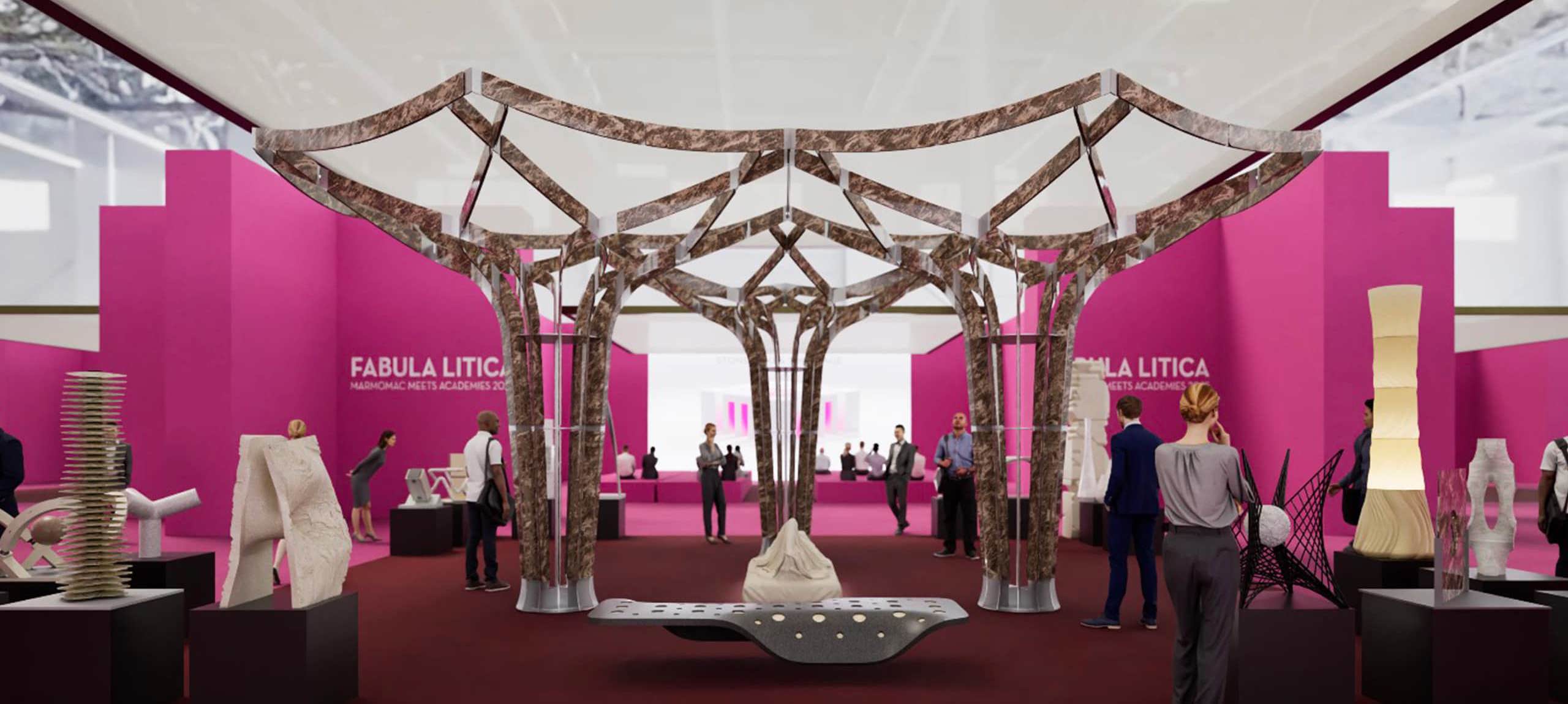
Marmomac Meets Academies 2025 places at the centre of the visitor’s reflection the “fairy-tale” theme of the infinite creative potential linked to the use of stone in architecture and design. Titled Fabula Litica, the exhibition invites visitors to immerse themselves in a dreamlike narrative in which past, present and future merge into a harmonious balance between tradition and innovation.
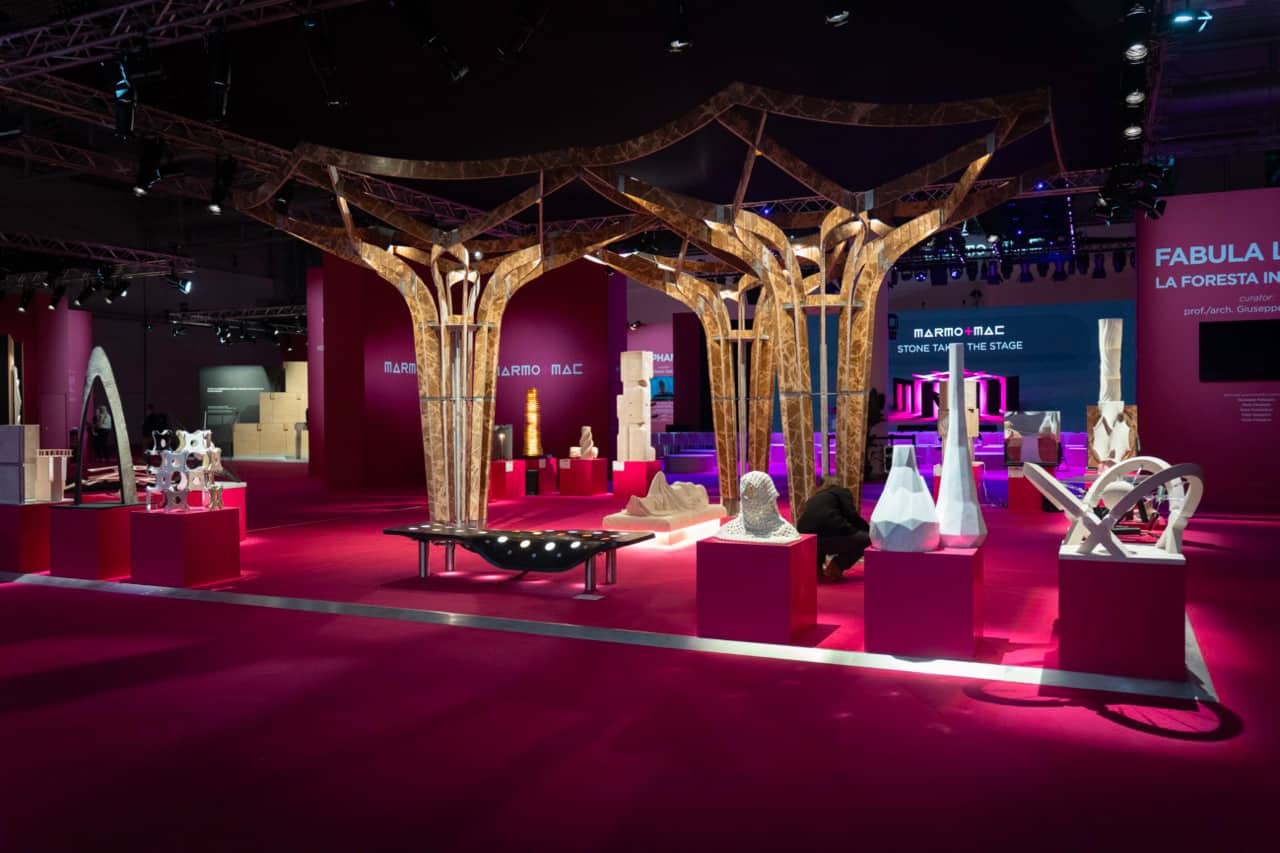
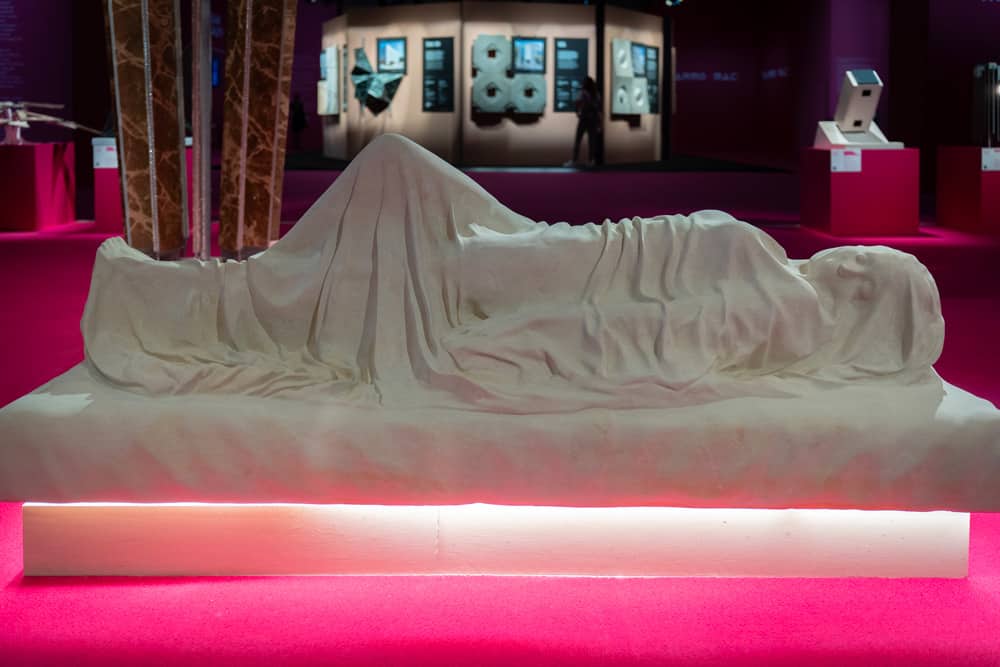
At the heart of the installation stands an evocative stone sculpture inspired by Giuseppe Sanmartino’s famous Veiled Christ, depicting a female figure recalling the story of Sleeping Beauty. The Veiled Maiden, wrapped in eternal calm, lies protected beneath a majestic tree-like structure. Three imposing, intertwined trees symbolise an ongoing dialogue between natural forms and materials and emerging construction techniques. Made of steel clad in thin brown radica stone quarried in Alberobello, the arboreal structure embodies the principles of innovation and a deep connection to tradition. This synthesis is also reflected in all the prototypes exhibited, created through a combination of craftsmanship and advanced technologies, revealing original solutions to specific research themes.
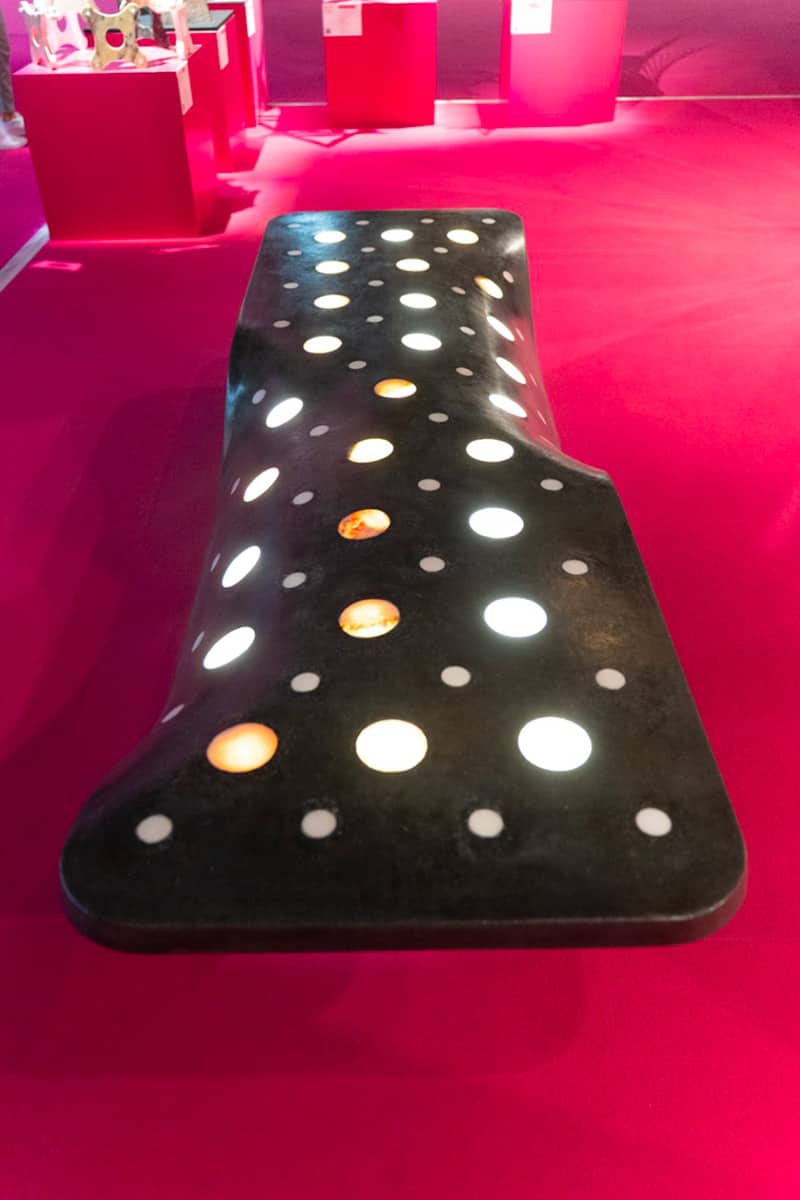
In front of the lithic forest, suspended above the ground, a Flying Carpet embellished with luminous onyx decorations serves as a bench for rest and arrival in the enchanted place. The entire exhibition space, suspended between storytelling and wonder, is filled with surprises: fantastic objects born from research and constructive experimentation.
The installation is conceived as a sculpted fairy tale, where every detail invites visitors to reflect on the narrative potential of stone—capable of preserving millennia-old stories and inspiring future scenarios. The true protagonists of MMA2025, alongside the stone prototypes, are young creatives from Schools of Architecture, Industrial Design, Fine Arts Academies and Engineering from Italian and international universities. They actively animate the space in collaboration with stone industry companies, presenting their projects and illustrating scenarios and potential future applications for architecture and design.
Apriti Sesamo
Desginers
Professor Giuseppe Fallacara, Sara D’Adamo
Academic Institution
Politecnico di Bari
Affiliated Companies
Màrlux Marmi
Material Used
Alboris marble on honeycomb panels
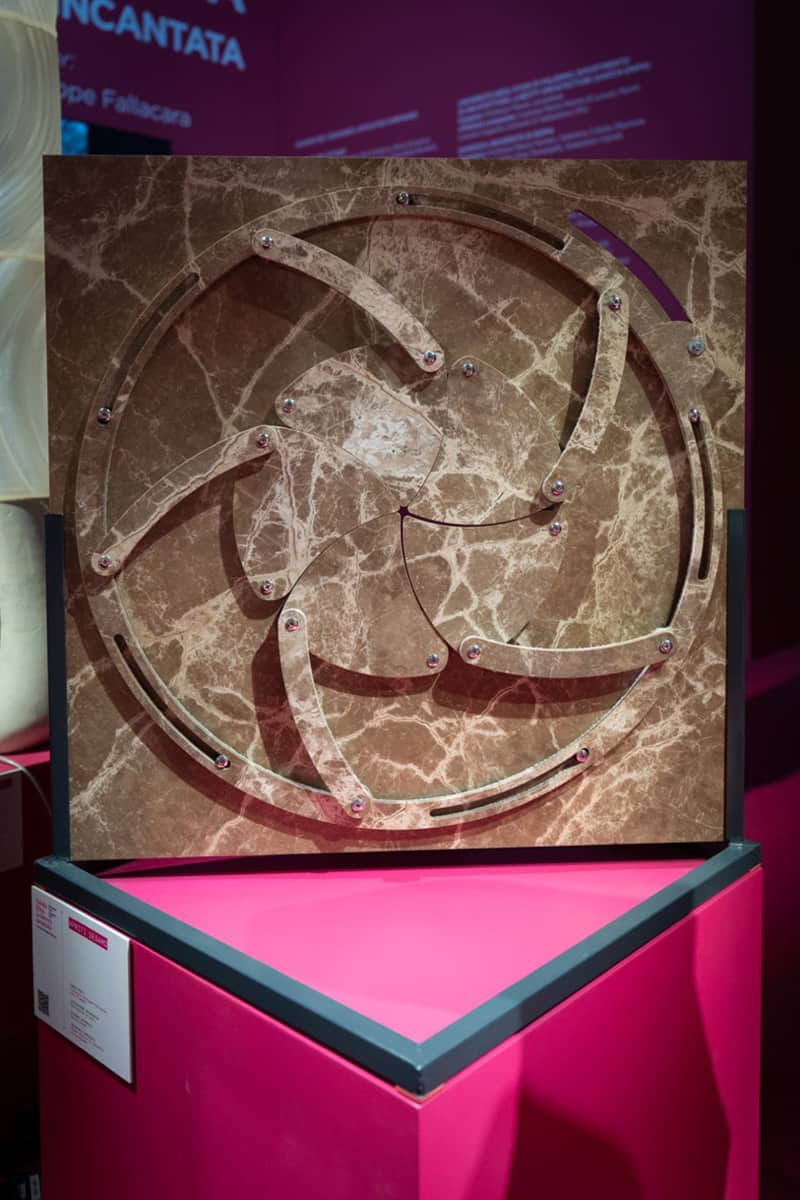
Apriti Sesamo is an innovative kinetic façade system designed to optimise natural light and improve building energy efficiency. Made of lightweight dolomitic marble, it features movable petals that automatically open and close in response to external light through an integrated mechanism. The module can be replicated to create a dynamic façade, combining aesthetics and functionality while optimising visual and thermal comfort.
Metamorphosis
Desginers
Professor Giuseppe Fallacara, Maria Giovanna Pansini
Academic Institution
Politecnico di Bari
Affiliated Companies
Màrlux Marmi
Material Used
Alboris dolomitic marble on honeycomb panels, stainless steel
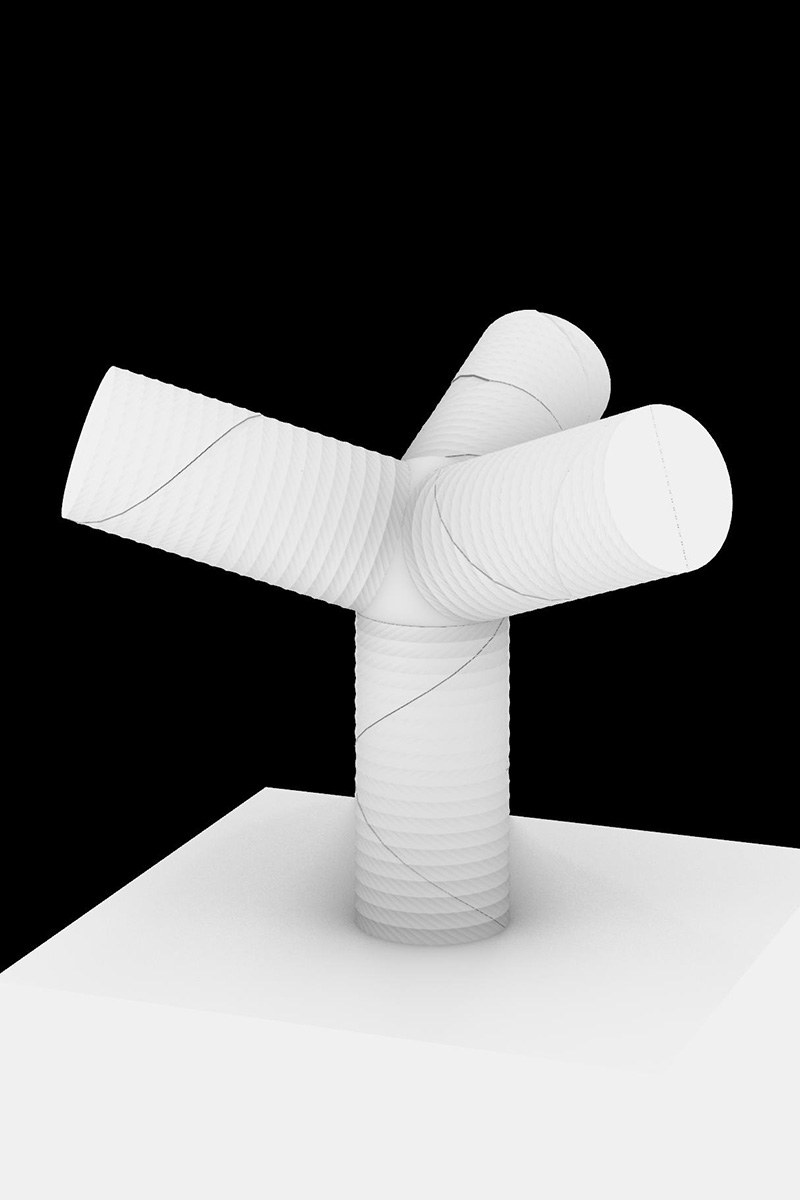
The Metamorphosis installation combines steel and Alboris dolomitic marble to create three lithic trees approximately four metres high, with distinct trunks and intertwined branches in a suspended embrace. The stone material captures light through its tonal variations, transforming into narrative. Based on modularity and experimentation, the structure is reconfigurable thanks to its mechanical connections. The project reinterprets fairy-tale traditions in a contemporary key, uniting tradition and innovation in a harmonious dance.
La Colonna dei Mondi
Desginers
Ilaria Cavaliere, Dario Costantino
Academic Institution
Politecnico di Bari
Affiliated Companies
Bianco Cave, FabLab Poliba
Material Used
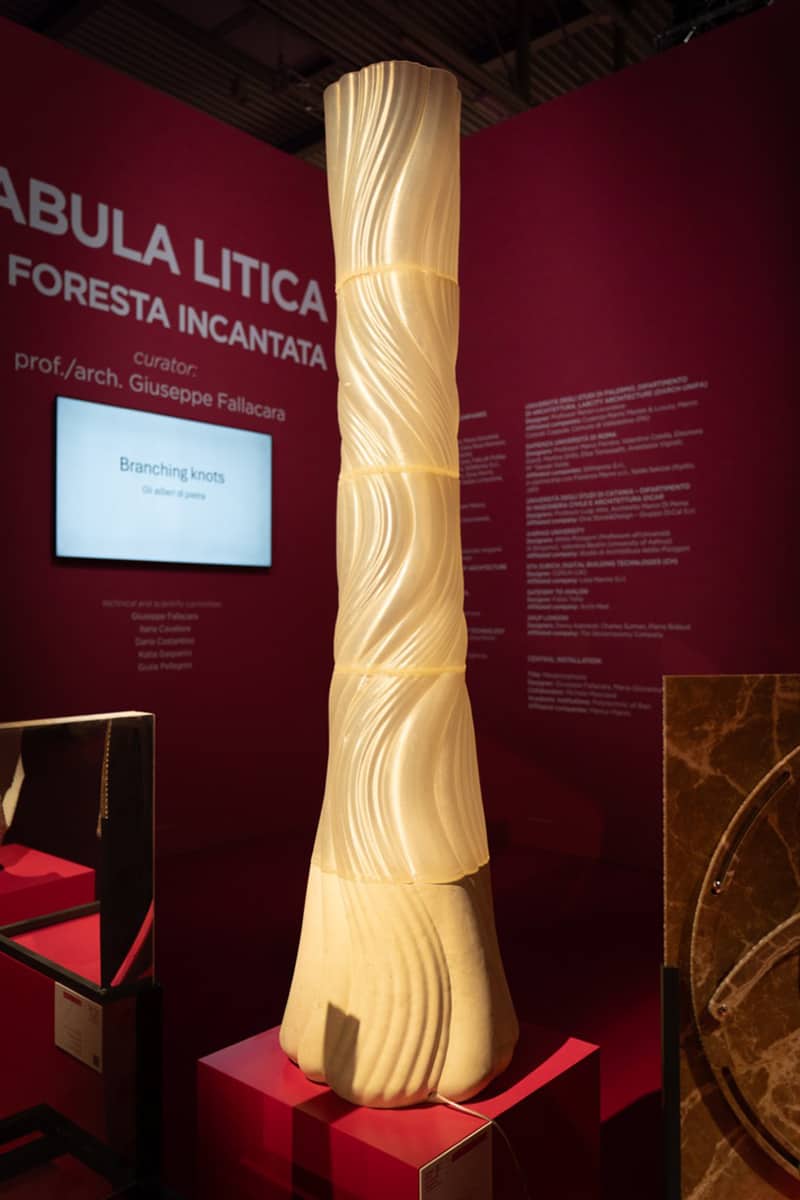
Lecce stone and 3D-printed PLA
The Column of Worlds reinterprets Yggdrasil, the cosmic tree of Norse mythology, as a lithic axis connecting the nine realms. Composed of a stone drum and four 3D-printed PLA modules, it combines tradition and innovation. The translucency of the PLA allows for internal lighting, evoking the vitality of the mythical tree through matter and light.
Janas
Desginers
Professoressa Katia Gasparini, Miriam Manca, Francesco Capula, Agostino Coccoi
Academic Institution
Università degli Studi di Sassari
Affiliated Companies
Marmi Regina srl, SiderColorVeneta, Progetto Luce
Material Used
Green onyx
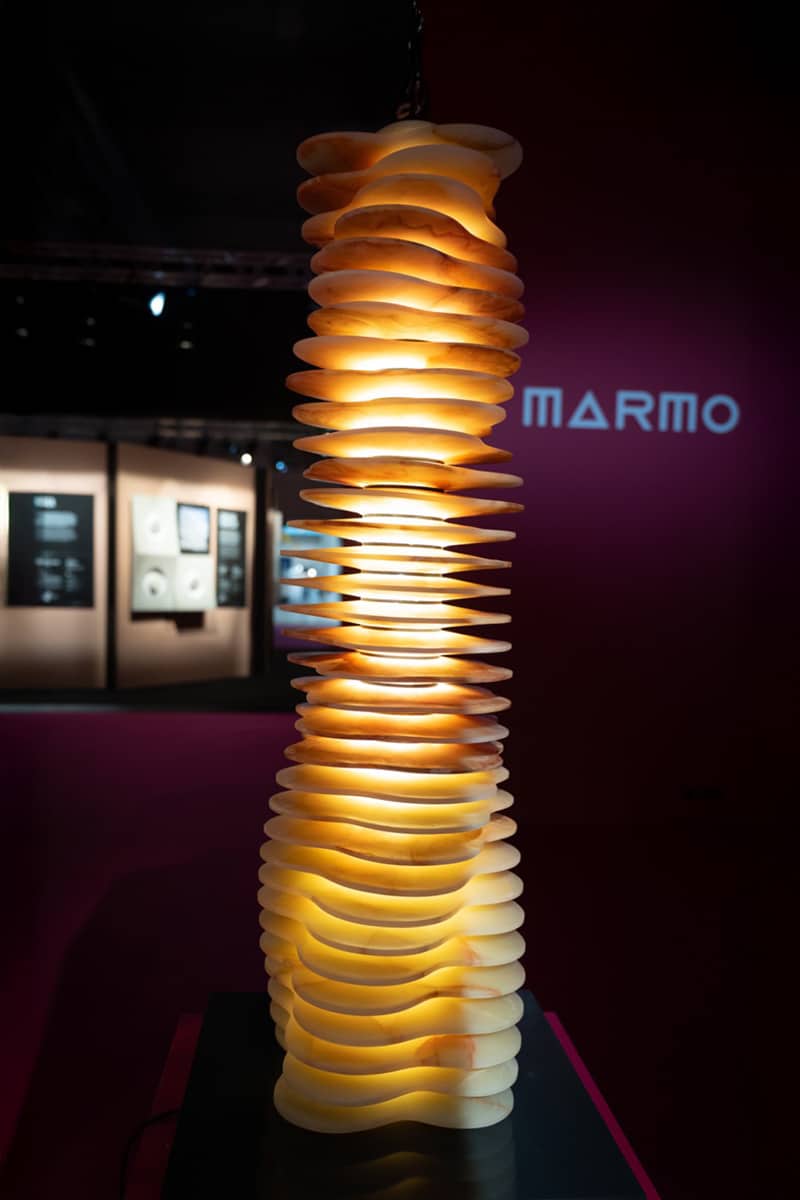
Janas is a luminous onyx sculpture that integrates light and matter into a fluid, dynamic body. Inspired by Sardinian mythology, it reinterprets ancient knowledge in a contemporary way. Its organic geometry, based on metaball algorithms, generates a vertically growing module. Internal lighting enhances the onyx veining, creating a narrative, sensitive and modular object capable of adapting to multiple configurations.
Minimal Vault
Designers
Professor Giuseppe Fallacara, Francesco Ciriello
Academic Institution
Politecnico di Bari
Affiliated Companies
Vertico, Stilmarmo, B&Y
Collaborators
Orestis Pavlidis, Jun Lee
Material Used
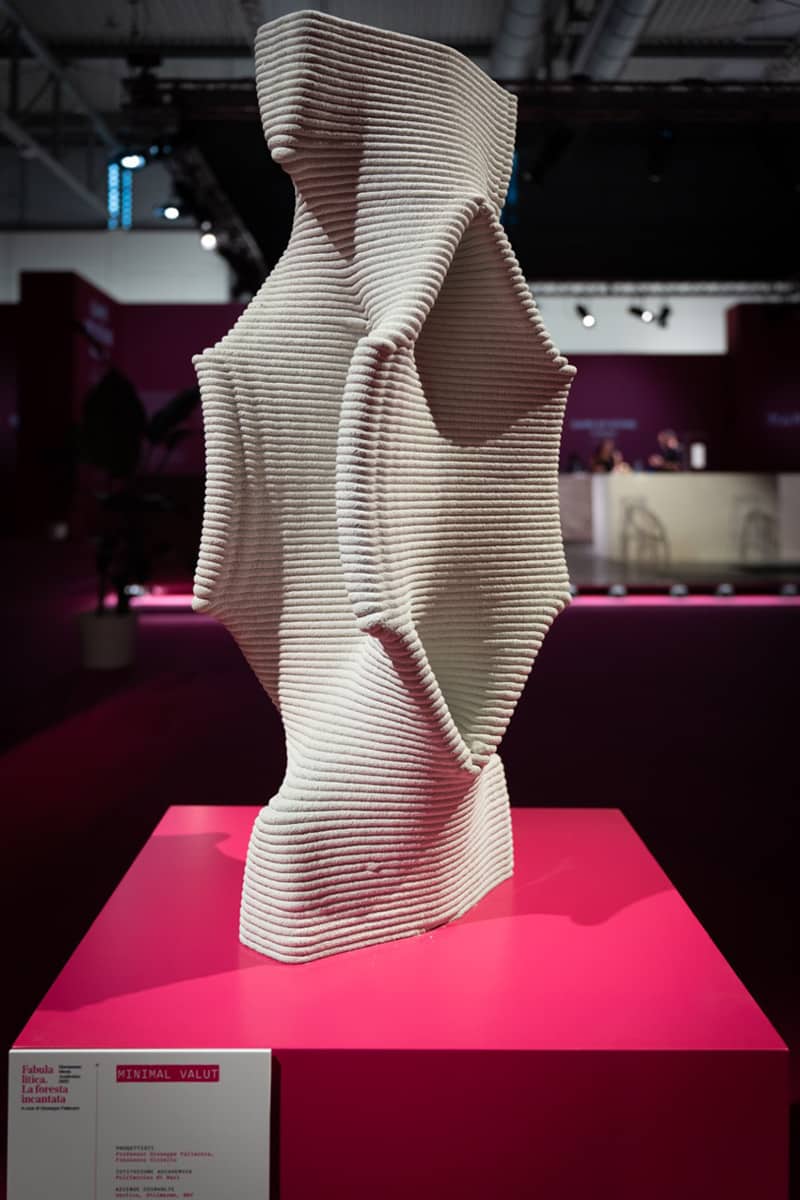
3D-printed concrete with marble-processing waste powders
Minimal Vault is a stereotomic bridge composed of nine curved voussoirs arranged along an arch working entirely in compression. Each voussoir consists of four “Minimal Bricks”, units derived from minimal surfaces inspired by the studies of Sergio Musmeci. Robotically 3D-printed in concrete and marble powder, each block weighs 42 kg and has a thickness of 3.5 cm. The structure, 3.5 metres long and 1 metre wide, is self-supporting thanks to two Apricena stone blocks.
Sisyphus Absurd Hero
Designers
Professor Anthony Caradonna, Alessandro Angione
Academic Institution
New York Institute of Technology, Politecnico di Bari
Affiliated Companies
Romagno Marmi, Archimed
Material Used
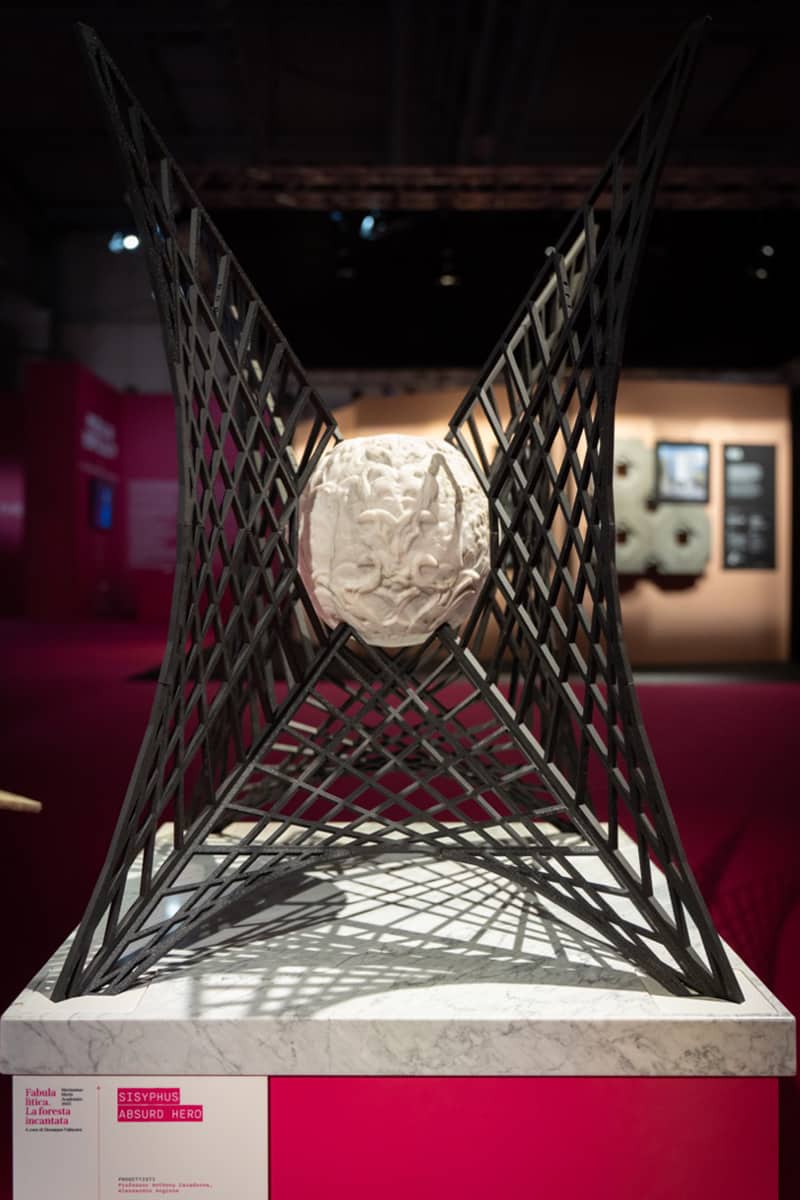
3D-printed carbon fibre, Verde Alpi marble
“The struggle itself towards the heights is enough to fill a man’s heart. One must imagine Sisyphus happy.”
— Albert Camus
“While Sisyphus is condemned to an endless task, his story can be interpreted through the lens of the hero’s journey, where struggle and acceptance of destiny lead to eternal transcendence.”
— Joseph Campbell
The engraved stone sphere of Sisyphus is suspended within a 3D-printed carbon fibre net, representing his destiny nested within the omni-trajectories of his liminal state.
Baroque Glitch: Portal Fragment
Designers
Professor Dustin White
Academic Institution
Florida Atlantic University School of Architecture
Affiliated Companies
Conc3DE
Material Used
Binder jet 3D-printed stone
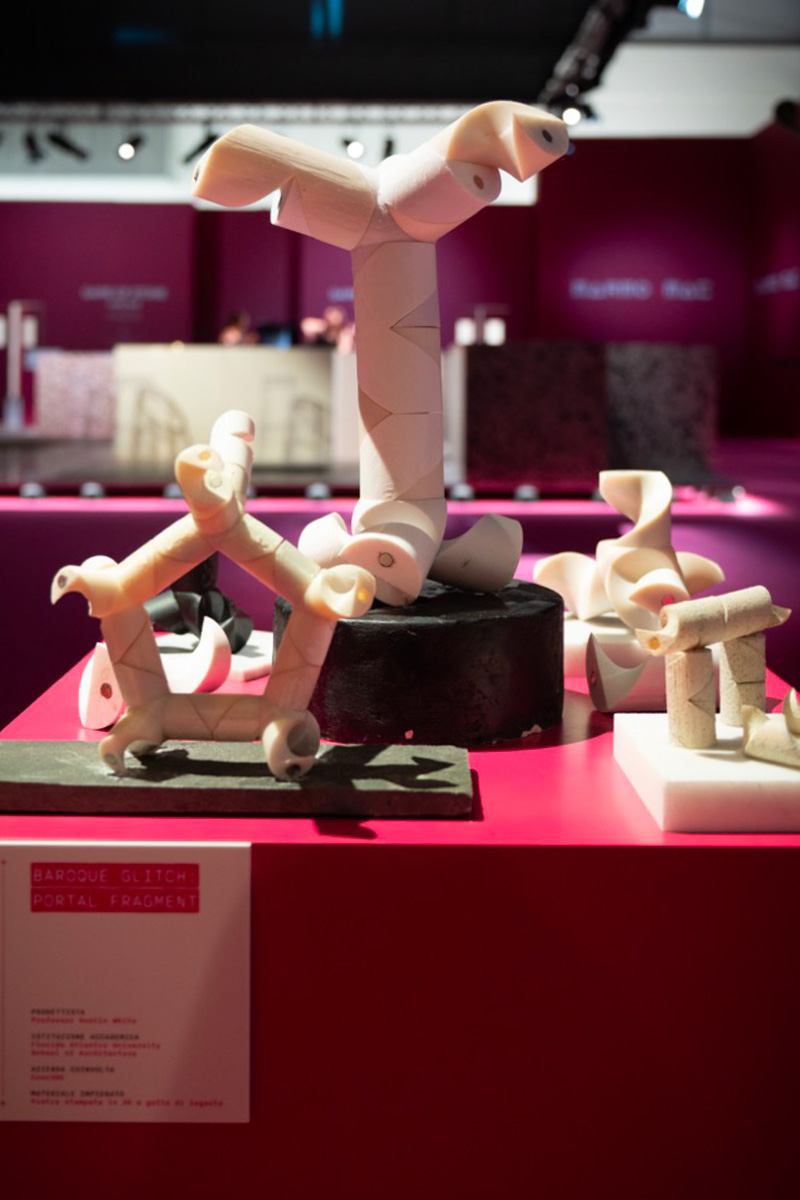
This architectural fragment functions as a portal, carved in stone using distorted stereotomy and embedded with a continuous AI-generated neo-baroque inlay. Wrapping both faces, the ornament challenges flatness, recalling Borromini’s dynamic surfaces while reinterpreting them through digital distortion. The work invites movement and shifting perception, merging structure, surface and hallucinated historical memory.
Umra: The Stone Held by Shadow, the Pact That Is Unseen
Designers
Professor Giuseppe Fallacara, Clara Rosa Romano
Academic Institution
Politecnico di Bari
Affiliated Companies
Stilmarmo
Collaborators
Giacinto Consiglio, Rossana De Ruvo, Mariolina Di Pinto, Andrea Petruzzella, Valeria Tandoi, Donatella Triggiani, Pierangelo Urso
Material Used
Apricena stone, black enamelled metal, cementitious conglomerate with stone powder
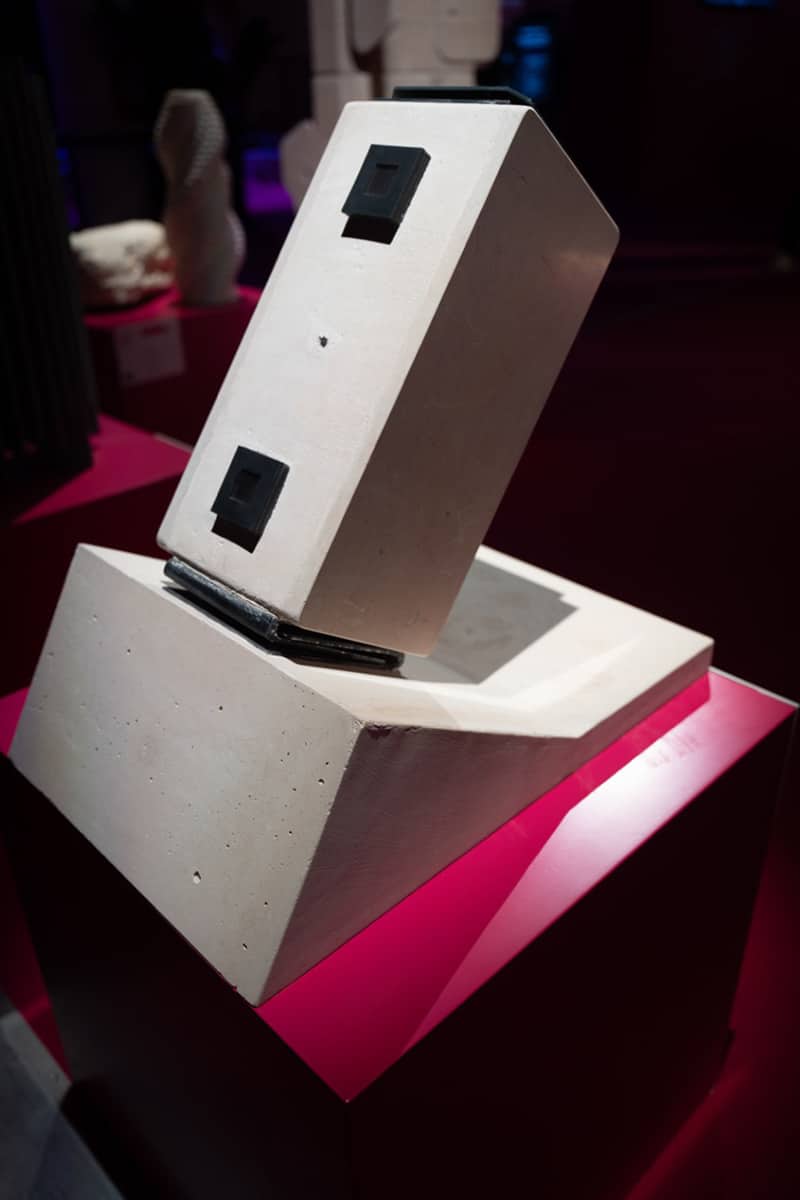
Umra is a self-supporting arch composed of cement blocks enriched with stone powder, clad with 2 cm-thick Apricena stone slabs. The dry assembly requires no centring, relying instead on precise joints and black enamelled metal clamps, U-shaped and inverted U-shaped, ensuring stability and formal coherence. The mineral aesthetics of the stone skin merge with the materiality of the cement core, achieving a balance between visual lightness and structural solidity. The project reinterprets the archetype of the arch in a contemporary key, synthesising reinvented material and essential constructive gesture.
The Invisible Self
Designers
Marco Massafra
Academic Institution
Politecnico di Bari
Affiliated Companies
FabLab Poliba
Material Used
3D-printed PLA with marble powder coating
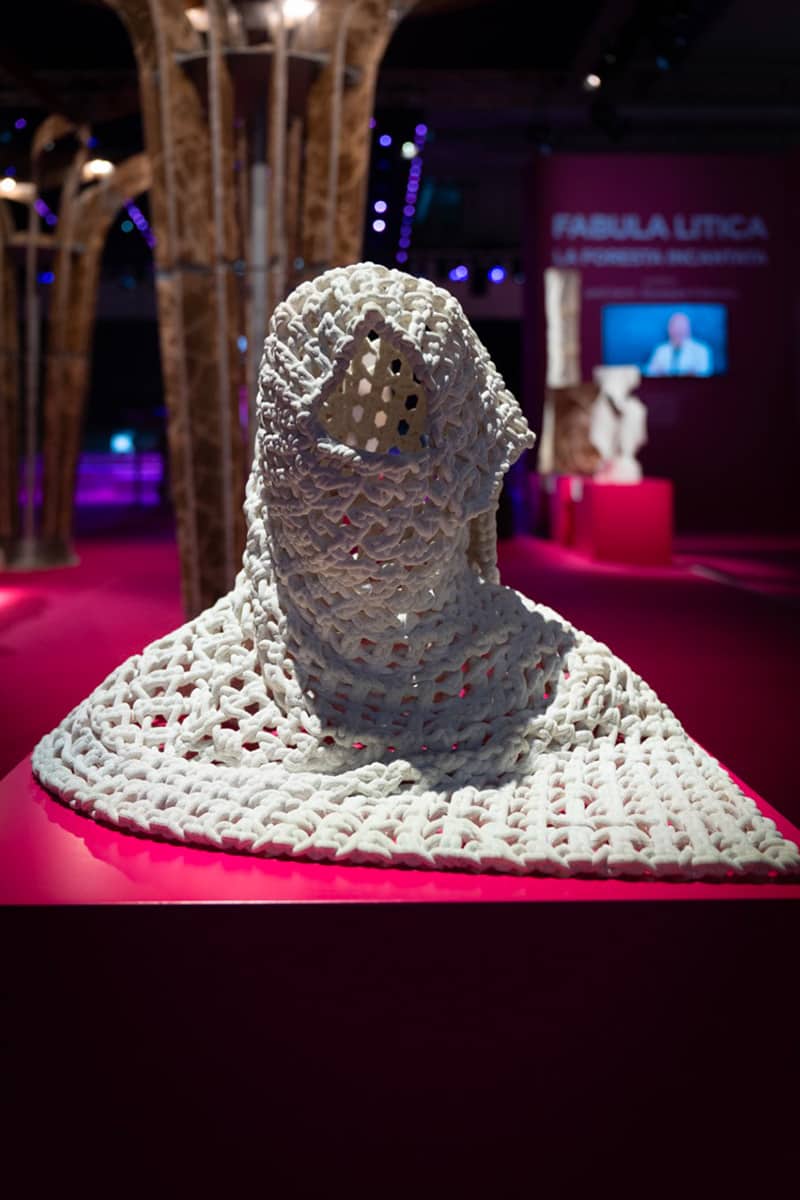
The Invisible Self reflects on the duality between visibility and invisibility, identity and illusion. The work originates from a 3D scan of the artist’s torso, combined with the modelling of a hexagonal knotted mesh in a twill pattern. Measuring 58 × 57 × 44 cm, the piece was 3D-printed using Carrara marble powder filaments. The face, concealed behind the mesh revealing only the eyes, explores the relationship between identity and perception, inviting reflection on what lies beneath appearances.
The Flying Carpet
Designers
Francesco Fallacara, Marisa Divella
Academic Institution
Università degli Studi della Basilicata, Prof.ssa Chiara Rizzi
Affiliated Companies
Mastropasqua Marmi, Tarricone Prefabbricati di Tarricone Francesco
Material Used
Reconstituted stone, onyx, Carrara white marble
Inspired by the fairy-tale icon from One Thousand and One Nights, The Flying Carpet is a suspended platform redefining space and time. Modular and mobile, it generates a dynamic experience adaptable to different urban contexts. Light and flexible, it challenges the static nature of traditional squares and invites the public into an ever-evolving exploration.
Digital Shamir: Stone, Dust, Robots
Designers
Professor Aaron Sprecher, Ofer Asaf, Eliad Michli
Academic Institution
MTRL Lab, Technion – Israel Institute of Technology
Affiliated Companies
N-Form
Collaborator
Pavel Larianovsky
Material Used
Quarry dust from Jerusalem stone
The shamir, a mythical creature capable of cutting stone without contact, is said to have helped King Solomon build the First Temple without metal tools. Jerusalem stone, used in the Temple, embodies a sacred and territorial identity. Today, a robotic system transforms this stone into a printable material, merging tradition and innovation. The process reinterprets the shamir as a form of digital craftsmanship, combining myth, computational design and local geology into a new mode of material expression.
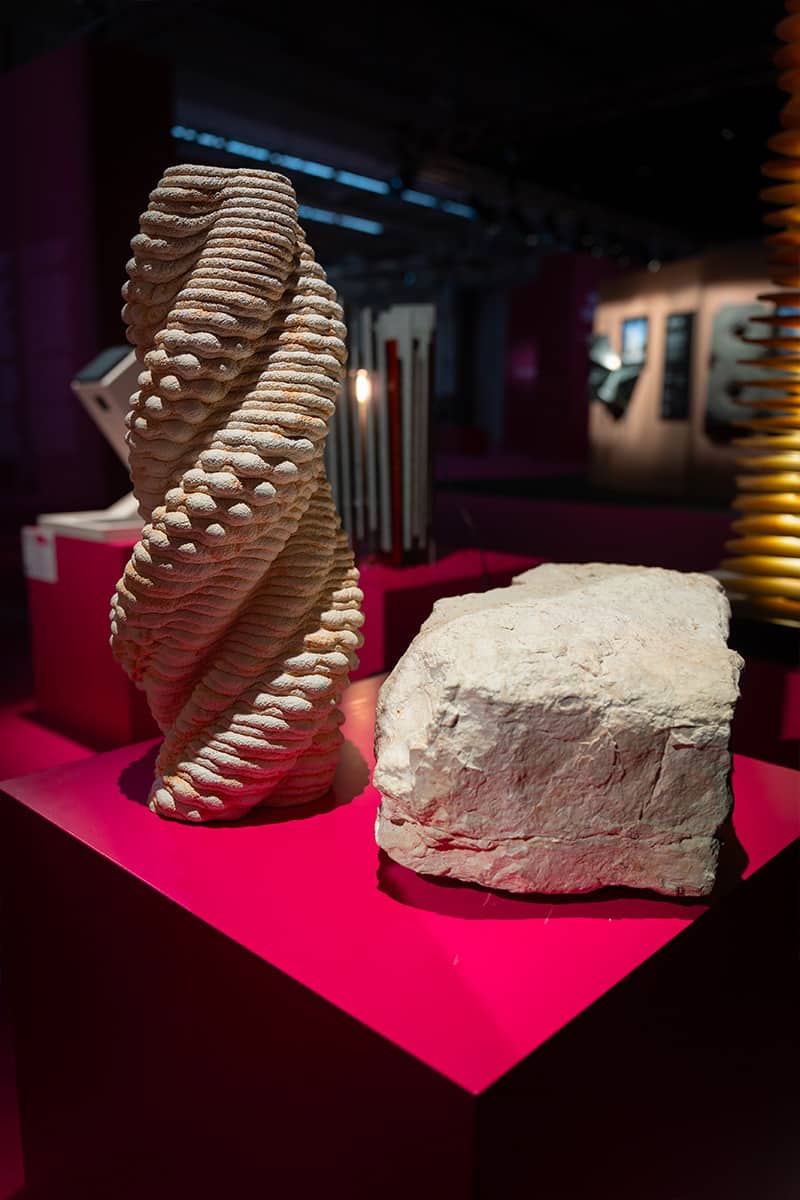
Meandro
Designers
Studio Gheda (Italo Boccuto, Andrea Sgherza, Giuseppe Tota)
Academic Institution
Politecnico di Bari
Affiliated Companies
Stoneform; Sibilia S.r.l.
Material Used
Calacatta Bianco marble, Verde Guatemala marble, wood
Meandro is a sculptural module inspired by the labyrinth of Daedalus and the meander motif. Composed of three elements—marble cylinders of varying lengths and curved wooden nodes with a steel core—it develops without beginning or end. Each component connects to the next, forming a continuous, modular and potentially infinite structure.
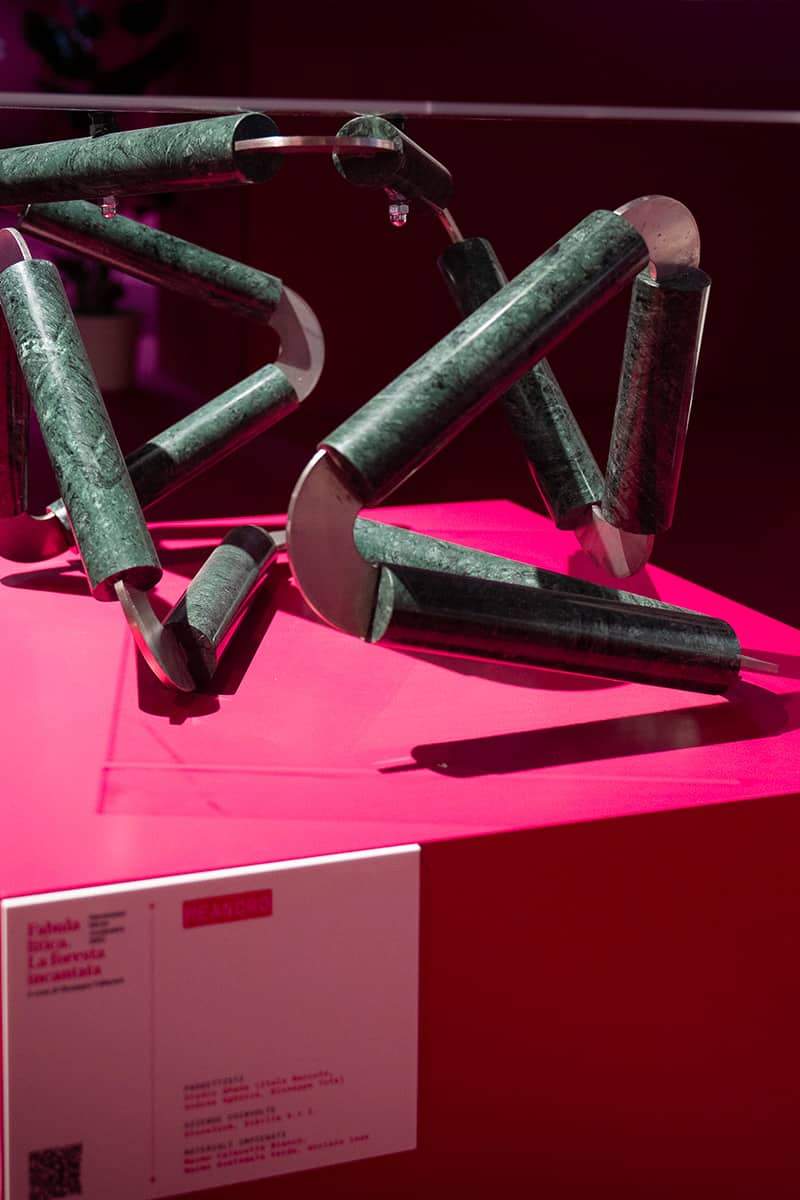
Diamond Line
Designer
Professor Stefano Chiocchini
Academic Institution
IID – Istituto Italiano Design
Affiliated Companies
CJSC ZIRKON Ltd.
Collaborator
Alex Chiocchini
Material Used
White Velvet stone (Tajikistan)
The Diamond Line product collection draws inspiration from precious materials hidden within mountains and frequently featured in fairy-tale narratives (Snow White and the Seven Dwarfs, The Lord of the Rings, etc.). The objects feature irregular facets reminiscent of raw diamonds extracted from mines—fantastical, precious forms that are extremely complex to manufacture, individually polished and striking in their ability to reflect light.
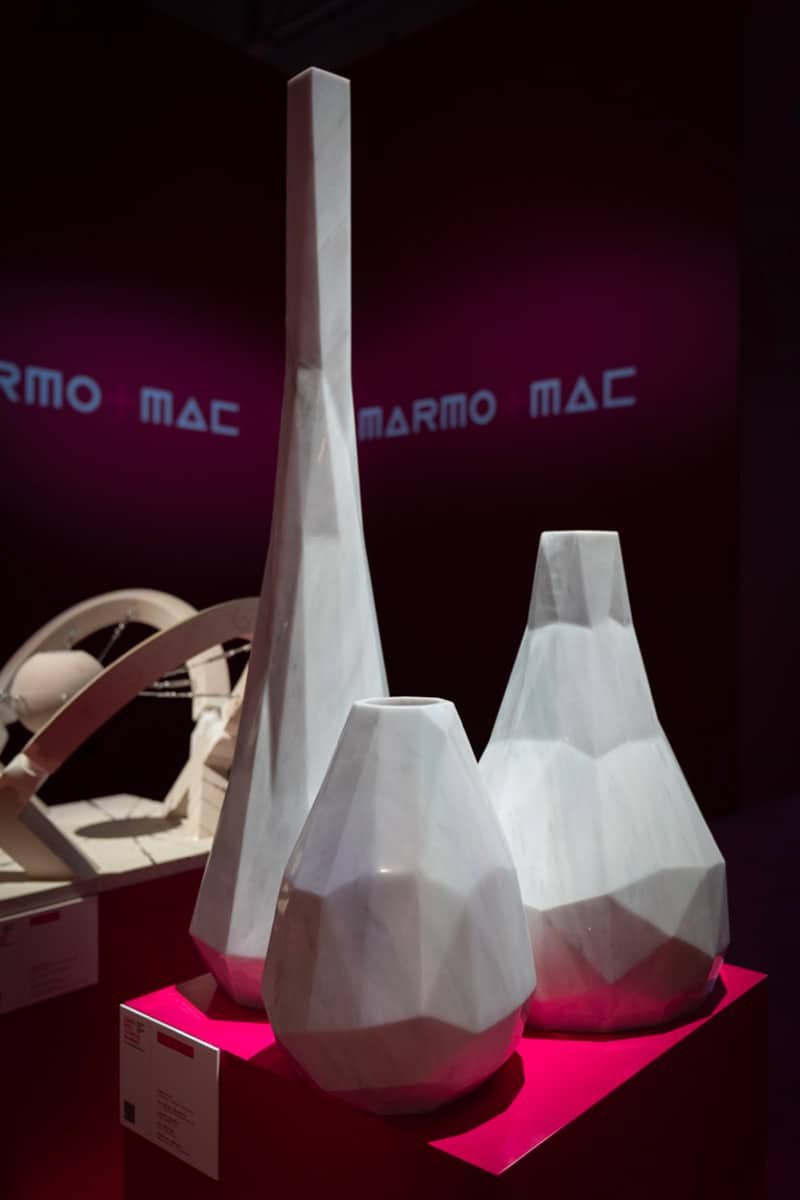
Mirror of Desires
Designers
Professor Giuseppe Fallacara, Adriana Valentini
Academic Institution
Politecnico di Bari
Affiliated Companies
Gioia Marmi, Marlè
Material Used
Alabaster and glass, Apricena stone, mirrored plexiglass, LED lighting
The project is a modular lithic cladding panel for architectural façades, composed of a stone surface and an outer plexiglass layer. A series of parabolic cavities carved into the stone surface, arranged in a decreasing pattern towards the edges, amplify the light coming from behind. The plexiglass is coated with a darkening film, transforming it into a mirror in low-light conditions and revealing the carved pattern when illuminated.
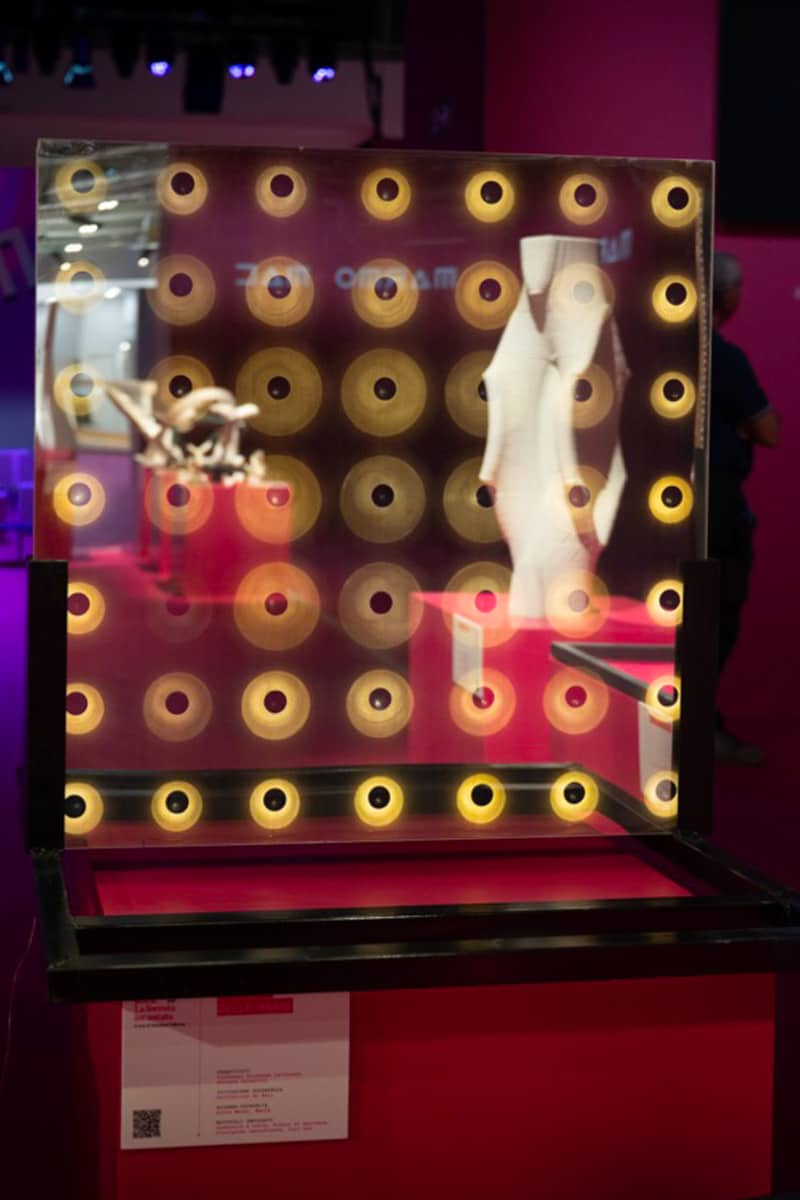
Curtain of a Thousand Stories
Designer
Professor Renzo Lecardane
Academic Institution
University of Palermo, Department of Architecture – LabCity Architecture (DARCH-UNIPA)
Affiliated Companies
Cusenza Marmi Marble & Luxury, Marmi Colorati Coppola,
Municipality of Valledolmo (PA)
Collaborators
Arch. Sarah Rosa Torregrossa,
Arch. Eloisa Gizzi
Material Used
Custonaci marble, galvanised HEB beam, semi-raw brass sheet
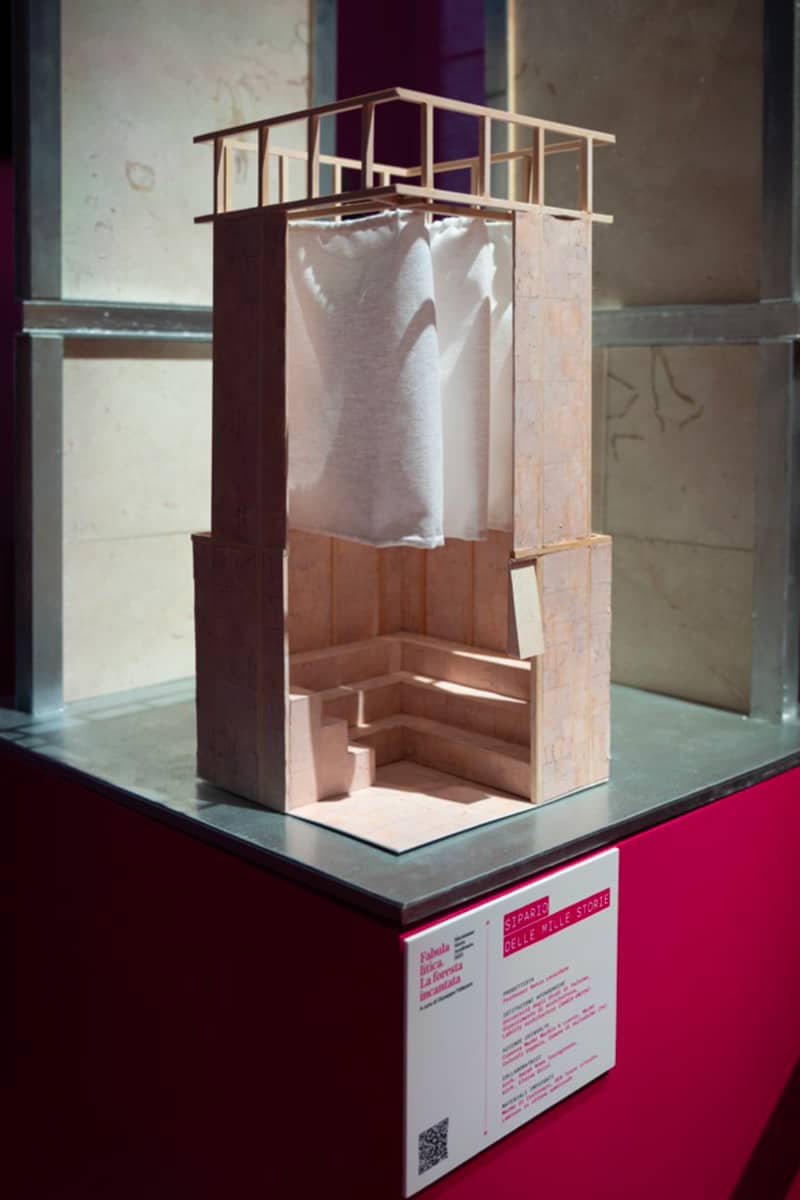
The Curtain of a Thousand Stories is a temporary pavilion that embraces the narratives of One Thousand and One Nights. Precise geometries evoke the ancient Greek bouleutéria—spaces of discussion and collective dialogue where space becomes politics and speech becomes action. The work explores universal themes such as power, justice, love and revenge, highlighting the strength of storytelling as a tool for overcoming adversity and transforming individuals.
The Stonetales Box
Designers
Professor Marco Ferrero, Valentina Colella, Eleonora Giardi,
Martina Grillo, Elisa Tomassetti, Anastasiia Vignati,
M° Takaaki Saida
Academic Institution
Sapienza University of Rome
Affiliated Companies
Stilmarmo S.r.l.
in partnership with Fiorenza Marmi S.r.l.,
Saida Sekizai (Kyoto, Japan)
Collaborators
Carlos Acosta Fontana, Elio Ravà, Kaito Saida
Material Used
Apricena stone
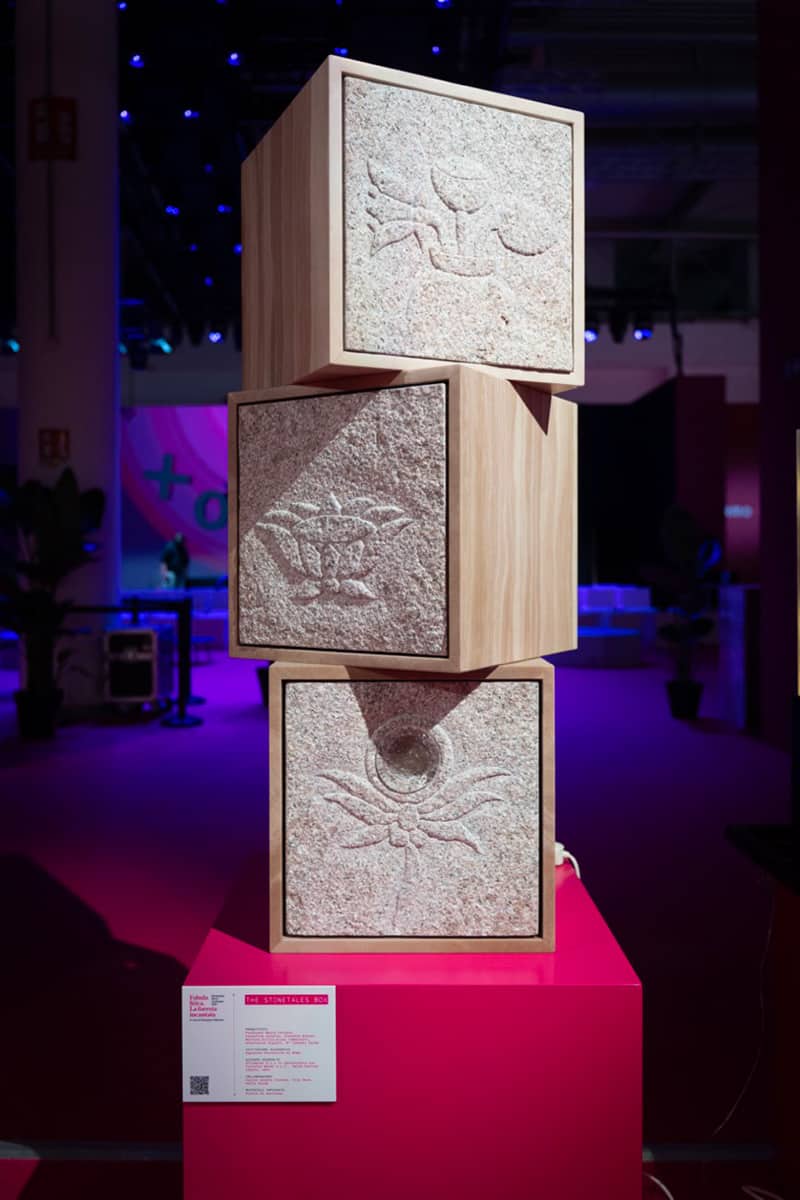
The Stonetales Box is an ambient lamp combining coloured light and graphic forms to evoke memories and emotions. It can function as a marker, a light source or even as seating. Modular by nature, multiple units can be stacked to form a luminous totem. The figurative component is interchangeable, allowing for sets of accessories that create related or dialectically contrasting visions. In reference to the MMA 2025 theme Fabula Litica, a prototype inspired by fundamental fairy-tale emotions—fear, hope and love—will be developed, evoked through simple English words.
La Corona del Moro
Stone Gridshell
Designer
Professor Giuseppe Fallacara
Academic Institution
Politecnico di Bari
Affiliated Companies
Màrlux Marmi
Collaborators
Sara D’Adamo, Maria Giovanna Pansini
Material Used
Alboris marble on honeycomb panels
The Stone Gridshell installation takes shape as a suspended sail made of lightweight dolomitic marble using honeycomb technology. Its thin, luminous surface interacts with air and light, evoking a sense of lightness and movement. The modular structure is anchored to the ground through a 3D-printed PLA base, ensuring stability and formal precision. The work combines advanced construction techniques with craftsmanship, offering a poetic and mutable presence capable of adapting and transforming.
Branching-Knot – The Stone Trees
Designers
Attilio Pizzigoni – former Professor at the University of Bergamo
Valentina Beatini – Aarhus University
Academic Institution
Aarhus University, Aarhus
Affiliated Companies
Attilio Pizzigoni Architecture Studio
Material Used
PLA filled with marble powder
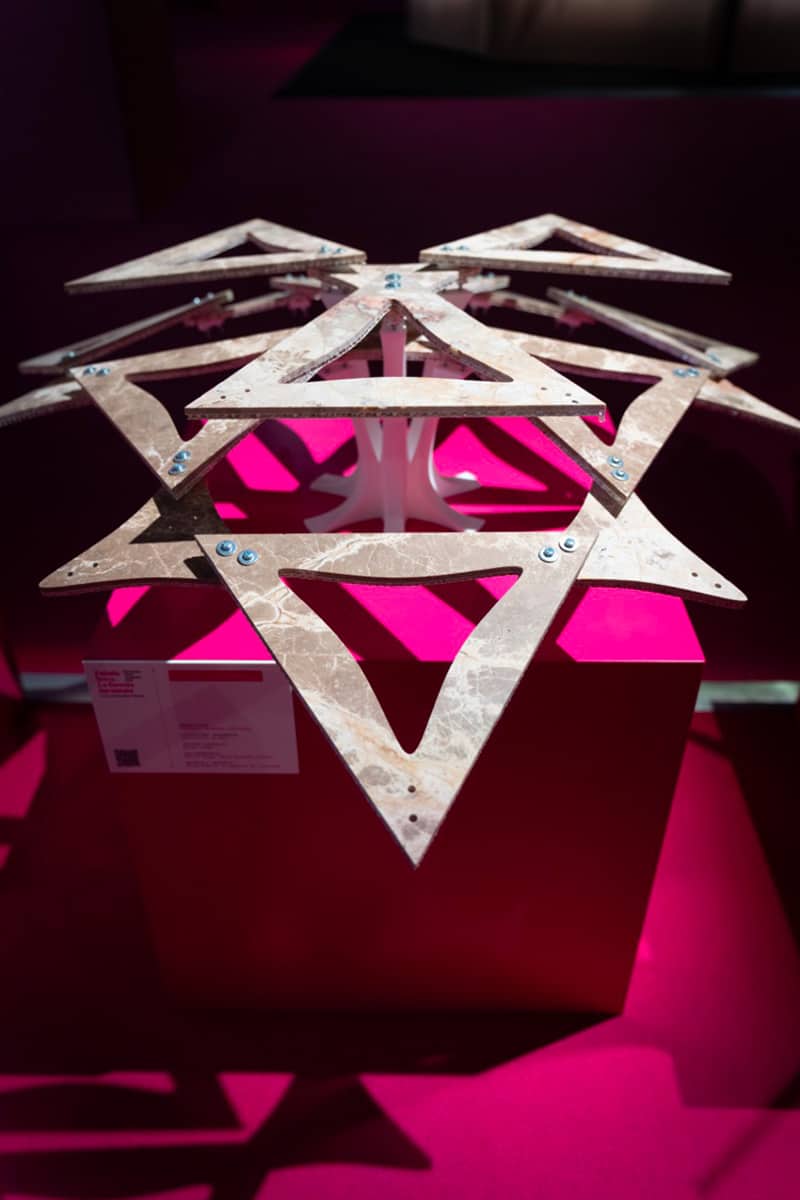
Assembled modular elements create complex architectural forms in a state of balanced structural tension. The construction system is inspired by organic growth, cell duplication, plant branching and the DNA spiral in organic cells. Elements are assembled through reciprocal contrast without the use of adhesives or mechanical connections, with equilibrium achieved through the material’s resistance and mass potential.
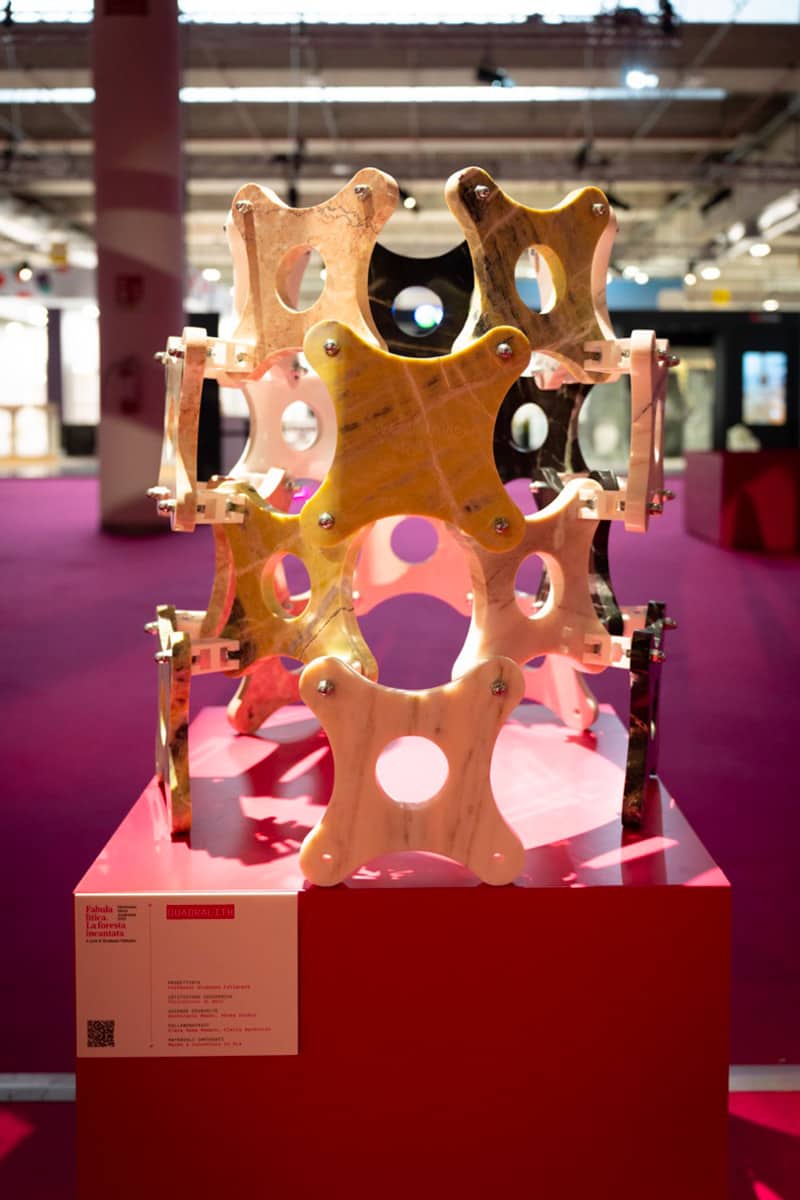
Quadralith
Designer
Professor Giuseppe Fallacara
Academic Institution
Politecnico di Bari
Affiliated Companies
Germinario Marmi, Otnas Studio
Collaborators
Clara Rosa Romano, Clelia Santovito
Material Used
Marble
Quadralith is a vertical stone column composed of stacked quadrangular modules, each centrally perforated to create a regular, openwork texture. The elements feature an interlocking or pinned joint system, ensuring structural stability. The height is proportioned for decorative or wayfinding architectural use. The structure is hollow, axially developed and constant in section.
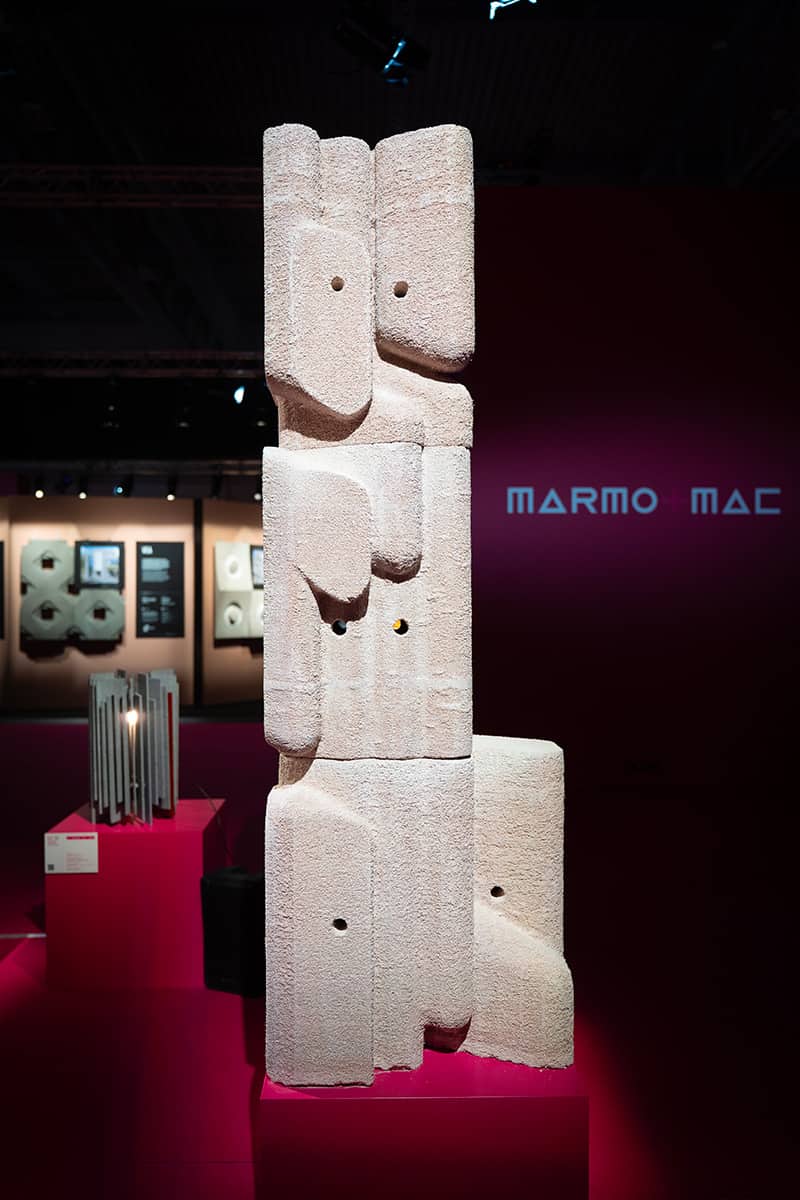
Anti-Ruin Phase 2
Designers
OZRUH (UK)
Academic Institution
ETH Zurich – Digital Building Technologies (CH)
Affiliated Companies
Lasa Marmo Srl
Collaborators
FormDP (UK)
Material Used
Proprietary mix – geopolymers and recycled marble aggregates
Anti-Ruin – Phase 2 reinterprets the column as a multifunctional element—both vertical and horizontal. 3D-printed using recovered stone powder, it demonstrates the potential of a new printing method developed at ETH Zurich, embodying structural versatility: capable of supporting, covering or aggregating. The project offers open potential for an architecture that adapts, evolves and resists decay, building upon the previous phase currently exhibited at the Venice Biennale within the Turkish Pavilion.
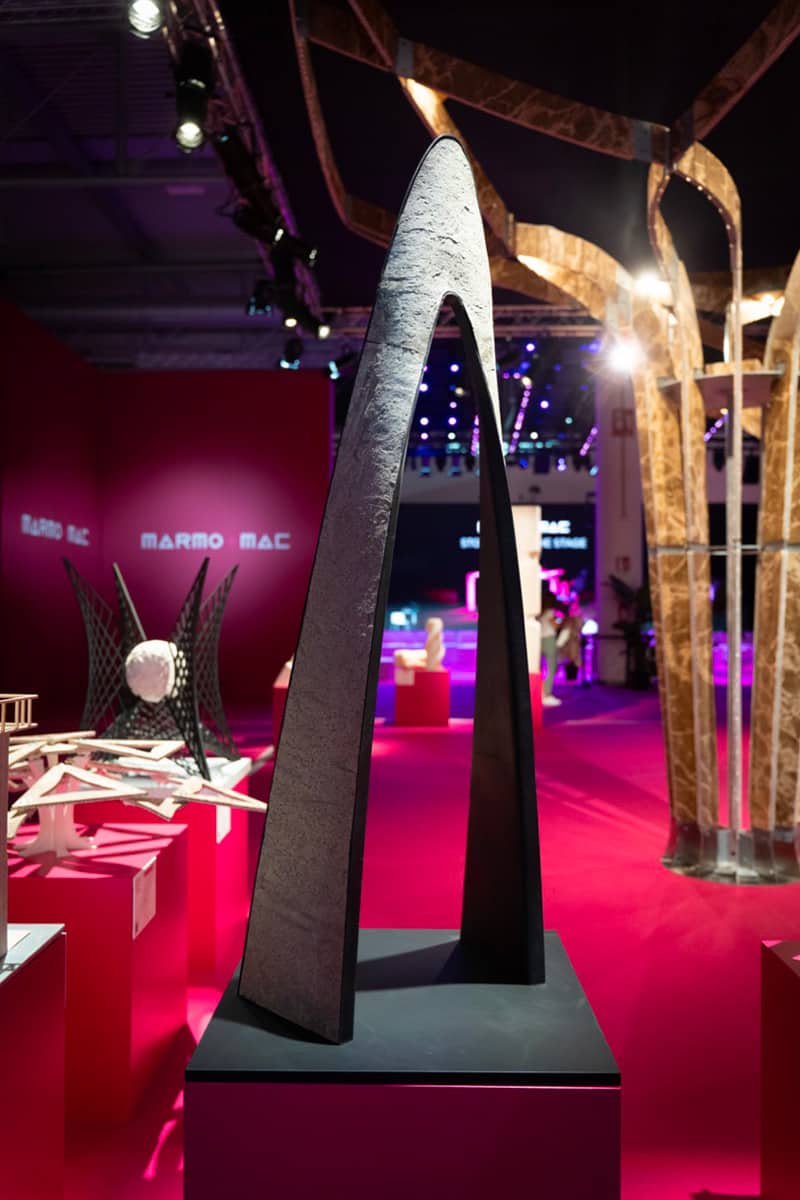
Gateway To Avalon
Designer
Fabio Tellia (Associate Architect at Foster + Partners)
Academic Institution
Politecnico di Bari
Affiliated Companies
Archi-Med
Material Used
PLA, flexible stone slabs
Inspired by the mythical Avalon, the portal explores the synergy between engineered lightness and poetic form, reinventing stone as a living, adaptable skin. It takes the form of a slender parabolic arch with a 3D-printed recycled PLA substructure clad in ultra-thin flexible stone sheets.
The Veiled Maiden
Designers
Professor Giuseppe Fallacara,
Francesco Ciriello,
Marco Massafra
Academic Institution
Politecnico di Bari
Affiliated Companies
Pimar Italian Limestone,
Archi-Med (3D scanning)
Material Used
Lecce stone
Model
Mimì Fallacara
The Veiled Maiden originates from a 3D scanning process used to create a detailed digital model of a young woman, onto which a virtual veil was applied through advanced mass–fabric simulation. The model was then processed using five-axis CNC machining at Pimar, roughing and finishing a Lecce stone block measuring 180 × 90 × 70 cm (531 kg). Final manual finishing with chisels and hammers enhanced sculptural details, completing a process that seamlessly merges technology and craftsmanship.
Why Not?
Designers
Danny Kalorkoti,
Charles Sulman,
Pierre Bidaud
Academic Institution
Arup
Affiliated Companies
The Stonemasonry Company
Material Used
Limestone (TBD), stainless steel ropes
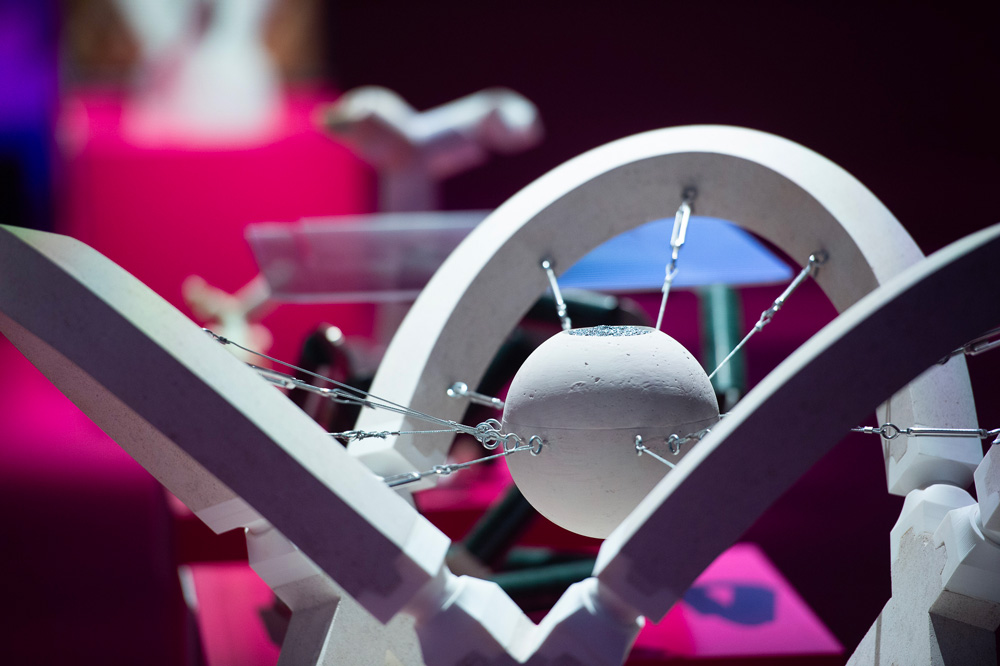
In Why Not?, three arches delicately balance one another, post-tensioned gravitationally by the weight of a suspended sphere rather than hidden internal cables. This generates a completely open and transparent structure characterised by a playful, geometry-driven approach. Designed to be scalable and span greater distances, the work challenges conventional methods of placing stone in compression and proudly invites the observer to explore every detail.